ASM Festival is a FUNSINCOPA project
The Alfredo de Saint Malo Festival is a project created by the Sinfonía Concertante Foundation of Panama (FUNSINCOPA), with the purpose of bringing together national and international musicians in a great cultural and artistic exchange, through various activities that enrich their knowledge and passion. musical; at the same time increasing the artistic cultural offer of Panama, offering classical music concerts of the highest level.
The Alfredo de Saint Malo Festival is one of the activities developed by FUNSINCOPA to create the financial sustainability of its programs, which by their nature require external financing. Once the cost of the Festival is covered, all remaining funds are allocated to the Panama Children’s and Youth Philharmonic Program, a musical education program aimed at children and young people from 7 to 25 years of age who are in risk and low resources; and other musical programs.
The Philharmonic offers children the opportunity to build a better future. We hope that through this education and musical practice, other life alternatives will be promoted that influence human development and a better quality of life, both for children and young people, as well as their families and communities.
A festival in honor of the violinist, Alfredo de Saint Malo.
Music, Education, Panama
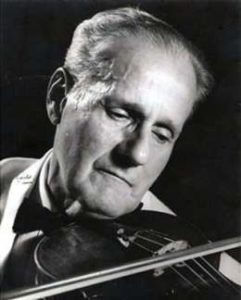
Alfredo De Saint Malo Orillac (1898-1984). Exceptional Panamanian violin virtuoso and teacher.
Alfredo De Saint Malo was born in Panama City on December 13, 1898. His parents were Don Rodolfo Bierman De Saint Malo, born in Curaçao, who arrived in Panama at the age of twenty to dedicate himself to business, and Doña Clementina Orillac, a distinguished lady of Panamanian society. Alfredo De Saint Malo began his musical studies with his father, who was a violinist, violist and also Consul of the Kingdom of Sweden in Panama. In a family environment that paid tribute to his taste for music, particularly for the violin, with his sister Helena and his brothers Augusto, Alberto, Guillermo and Rodolfo, his magnificent talent began to blossom. In 1907 he entered the School of Music that the Panamanian government had established at the dawn of the Republic, whose director was Don Narciso Garay, a famous violinist, composer, orchestra conductor, ethnomusicologist, essayist and diplomat. This school was elevated to the category of National Conservatory of Music and Declamation, the first of the republican era, in 1911, taking as models the conservatories of the old continent, and in particular the Paris Conservatory.
In 1915 Saint Malo received his Violin Diploma with First Place of Honor at the Panamanian Conservatory, by virtue of which, the following year, the government of the Republic of Panama, presided by Dr. Belisario Porras, granted him a scholarship to continue his studies at the Conservatory of Music in Paris, where he was admitted to the class of Dr. Edouard Nadaud. He also studied with Lucien Capet and Georges Enesco, and later with Oscar Morini in Vienna. In 1919, Alfredo de Saint Malo won in competition the First Prize for Violin and Gold Medal of the Paris Conservatory of Music, a fact that immediately launched him as a virtuoso to the main concert halls of Europe and America.
He began his career with a concert with the Orchestra of the Paris Conservatory, conducted by Diran Alexanian, and a recital, accompanied at the piano by the great French composer Gabriel Fauré, then director of the Conservatory. From then on, he performed in the most famous halls of Europe, with great success of public and press: Gaveau Hall, Paris; Wigmore Hall, London; Musikvereinsaal, Vienna; Bechteinsaal, Berlin; Zurich Conservatory Hall, Switzerland, and many more. A critic of the Paris newspaper Le Figaro wrote that in Saint Malo he found the great violin school of the highest masters, and that to his personality, in which temperament and virtuosity were united, was added his technique. The famous Parisian critic Vuillermoz, for his part, wrote, on Saint Malo’s performance in Paris, that it had given Parisians the opportunity to appreciate outstanding qualities, purity of style and intelligent and distinguished interpretation. This critic also pointed to her mastery of a pure and precise technique, and added that her phrasing always maintained balance. Berlin critics admired his interpretation of Tartini’s famous “Devil’s Sonata”, whose cadenza allowed him to demonstrate his dexterity and polyphonic skill. In Vienna, the Weltblatt newspaper referred to his “unusual maturity”, and to his passionate temperament, charged with emotion. And so the praise was repeated in London, Dublin, Edinburgh, Glasgow, Rome, Bologna; in short, all over Europe.
In 1926 he arrived for the first time in the United States. He performed five concerts at Carnegie Hall in New York, Orchestra Hall in Chicago, and in Boston, Philadelphia, Lexington, Oklahoma and many other American cities. At Symphony Hall, in Boston, he presented a recital with Maurice Ravel at the piano, in which he premiered the “Sonata in G for violin and piano”, by the aforementioned composer. From there he continued his career through the Caribbean to Puerto Rico; throughout Central and South America to Buenos Aires. In 1929 he made a concert tour of Italy, where he performed in the Sala Sgambati, in many other halls and in the Vatican, before Pope Pius XI, and later before his successor, Pope Pius XII. He was then invited to appear at Villa Torlonia before Benito Mussolini, nicknamed Il Duce. In the same year he was evaluated by the American magazine Times as one of the ten greatest violinists in the world. In 1939, he was invited to perform a concert at the White House in Washington D.C. for the President of the United States, Franklin D. Roosevelt and his wife, Eleanor Roosevelt. More than twenty years of triumphs in the old and new continent, sometimes alone with his accompanist, and other times as soloist of great orchestras, define the mark of the great violinist that was Alfredo De Saint Malo.
As a soloist, Saint Malo performed with the Orchestre du Conservatoire de Paris, the Hollywood Bowl Orchestra (1929), the Manhattan Symphony Orchestra (1930), the Orchestre Symphonique Poulet de Paris (1931), the Boston Pops Orchestra with Arthur Fiedler (1939), the Symphony Orchestra of Colombia (1938 and 1947), the Symphony Orchestra of the University of Mexico (1947), the Symphony Orchestra of El Salvador (1947), the Symphony Orchestra of Costa Rica (1947), and the Symphony Orchestra of Panama on countless occasions.
Saint Malo made several recordings, among which stands out a disc with music by Rimski Korsakov and Wieniawski for the RCA Victor label (red label No. 4163), with André Kostelanetz at the piano, who later had great success in his performances as a concert pianist and on the radio, and who married the famous soprano Lily Pons. The recording belongs to the collection entitled Historia Aumentada del Violín en Grabaciones, of which 250 copies were reproduced (1974-1976); also included in an album of Historia del Violín en Grabaciones on the Columbia label and in an album of Latin American composers (Heitor Villa Lobos, Oscar Lorenzo Fernández, Domingo Santa Cruz, Andrés Sas and Guillermo Uribe Holguín) with Nicolás Slonimsky, Fritz Magg and Olga Averino on piano, also on Columbia (M 437), all in 78 revolutions format.
In 1941, the government of Panama, presided over by Dr. Arnulfo Arias, established a Conservatory of Music and Declamation, the second in the republican era, and appointed Alfredo de Saint Malo as its director. After more than a decade of decline in the arts – due to the final closure of the first conservatory in 1927 – the opening of the new institution marked the beginning of an extraordinary renaissance, which once again had as models the great conservatories of Europe. Saint Malo summoned foreign and national professors of the highest quality and directed the conservatory towards an educational philosophy that aspired to raise the artistic standards of the entire Panamanian society. The professors, and later the students, constantly performed in evenings, recitals and concerts, not only in Panama City, but also in Colon and in the interior of the republic. Theater was greatly promoted, along with musical presentations. Since 1943, the magazine Armonía was published as an organ of the Conservatorio de Música y Declamación, initially directed by the Nicaraguan maestro and composer Luis A. Delgadillo, and later by the university professor of literature Enrique Ruiz Vernacci. The magazine Armonía not only reflected the musical environment of Panama, but also published articles by international personalities such as art critic Nicolás Slonimsky and Argentine composer Alberto Ginastera. The conservatory created its own orchestra of students and professors, directed by violinist Alexander Feinland and his wife, cellist Elizabeth Feinland. The Conservatory Orchestra reached high levels of perfection and had soloists of the stature of Eduardo Charpentier Herrera, a Panamanian flutist, and Nélida Odnoposoff, a great Argentine pianist. The members of the orchestra nurtured new elements to the new Panama Symphony Orchestra, then conducted by maestros Herbert de Castro and later Walter Myers. By the middle of the century, the Conservatory of Music and Declamation of Panama had forty professors in various disciplines and more than a thousand students. Such were the many contributions that Alfredo de Saint Malo made to his country. However, in August 1953, the Conservatory was closed by a government with no vision for the future, as a result of which Saint Malo was marginalized and resigned from his position.
In 1955 he was appointed professor of violin in the Department of Music of the College of Fine Arts at the University of Texas at Austin. The artist remained in Austin for many years, dedicated to teaching his instrument and training countless violin professionals in the United States. He returned to Panama frequently to give concerts, until his retirement.
Alfredo De Saint Malo died in Austin, Texas, in 1984.
More than half a century after the years in which the Conservatory of Music and Declamation flourished -from 1941 to 1953- the seeds that the great violinist of Panama, Alfredo de Saint Malo, sowed in that society are still bearing fruit. For example, the Fundacíón Sinfonía Concertante de Panamá, founded in 2008 by Professors Issac Miguel Casals and Luis Casals, created the Saint Malo Festival.
During his lifetime, Alfredo De Saint Malo received honors, medals and distinctions all over the world. Among them, the First Prize and Gold Medal of the Paris Conservatory (1919); the Crown of Gold Laurels, by public subscription, with the inscription “Homage of the Panamanian People” (1929); L’Ordre National of Haiti (1934); the Croix du Sud of Brazil (1949); Cross and Eloy Alfaro Medal of Ecuador (1952 and 1956); Les Palmes Academiques of France (1953). In 1956 he was made a permanent member of the International Institute of American Ideals; in 1961, a member of Pi Kappa Lambda of the University of Texas, and in 1963, he was awarded the Order of Vasco Nuñez de Balboa in the rank of Grand Officer of Panama.
Bibliography
Courtesy of the website: Alfredo de Saint Malo Orilla EnCaribe Encyclopedia of Caribbean History and Culture
Charpentier Herrera, Eduardo: Orquesta Sinfónica de Panamá, Editora de la Nación, Panamá, 1972.
Clear, Thomas L.: Augmented History of the Violin on Records. (1920-1950), New York, 1974-1976.
Íngram, Jaime: “Apuntes para una Historia de la música en Panamá”. (1903-2003); en Istmo, revista virtual de estudios literarios y culturales centroamericanos, No. 7, Noviembre diciembre 2003.
Mayer-Serra, Otto: Música y Músicos de Latino América, Atlante, México D.F., 1947.
Slonimsky, Nicolas: Music of Latin America, Thomas Y. Crowell, Nueva York, 1945.
World Biography, s.e. New York, 1943, 1946, 1948.
Wolfschonn, Erik: Las manifestaciones artísticas en Panamá: estudio introductorio y antología, Biblioteca de la Cultura Panameña. Universidad de Panamá, Panamá, 1983.